

Passport Is Not Proof Of Citizenship, Says MEA. So What Documents Establish Indian Citizenship?
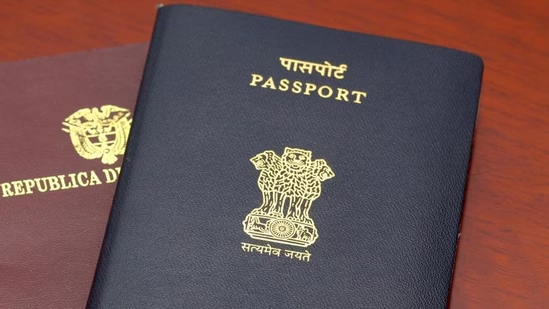
In a statement that has reignited a complex legal and political debate, the Ministry of External Affairs (MEA) clarified during the 14th Passport Seva Divas that an Indian passport is primarily a travel document and does not conclusively establish Indian citizenship.
While passports are strictly issued to Indian nationals to facilitate international travel, the MEA stressed that possessing one does not legally constitute absolute proof of citizenship by itself. Adding weight to this stance, Indian passports explicitly carry a note stating they remain the property of the Government of India and can be recalled or surrendered at any time.
If Not a Passport, What About Aadhaar or Voter ID?
The clarification has left many wondering which government-issued documents actually serve as legal evidence of citizenship. Recent rulings and observations have systematically disqualified other common identity markers:
- Aadhaar: The Supreme Court recently observed that Aadhaar functions strictly as a proof of identity and residence, not as conclusive proof of citizenship.
- Voter ID Card: Primarily designed for electoral purposes and establishing local residence, a voter card does not automatically confirm legal citizenship status.
Understanding Indian Citizenship by Birth
With common identity cards falling short of absolute legal proof, status is heavily dictated by the strict timelines outlined in Indian citizenship laws:
| Date of Birth | Citizenship Requirement |
| Jan 26, 1950 – July 1, 1987 | Automatically considered an Indian citizen by birth, regardless of parents’ nationality. |
| July 1, 1987 – Dec 3, 2004 | At least one parent must be a legally recognized Indian citizen. |
| On or after Dec 3, 2004 | Both parents must be Indian citizens, OR one parent must be a citizen while the other is not an illegal immigrant. |
Passport Infrastructure Sees Significant Growth
Alongside the legal clarification, the MEA highlighted major operational milestones for India’s passport network, noting that 1.5 crore passport and related services were successfully delivered in 2025 alone—including 1.39 crore individual passports.
Operational Upgrades: India’s network of passport service centers has expanded to 545 locations, up from just 77 a decade ago. Average wait times at Passport Seva Kendras have dropped to under 45 minutes, with standard passport issuance now taking just six working days (excluding police verification). The ministry is also actively rolling out advanced, chip-enabled e-passports.