

India, Uzbekistan agree to deepen ties, explore strategic partnership during PM Modi’s state visit
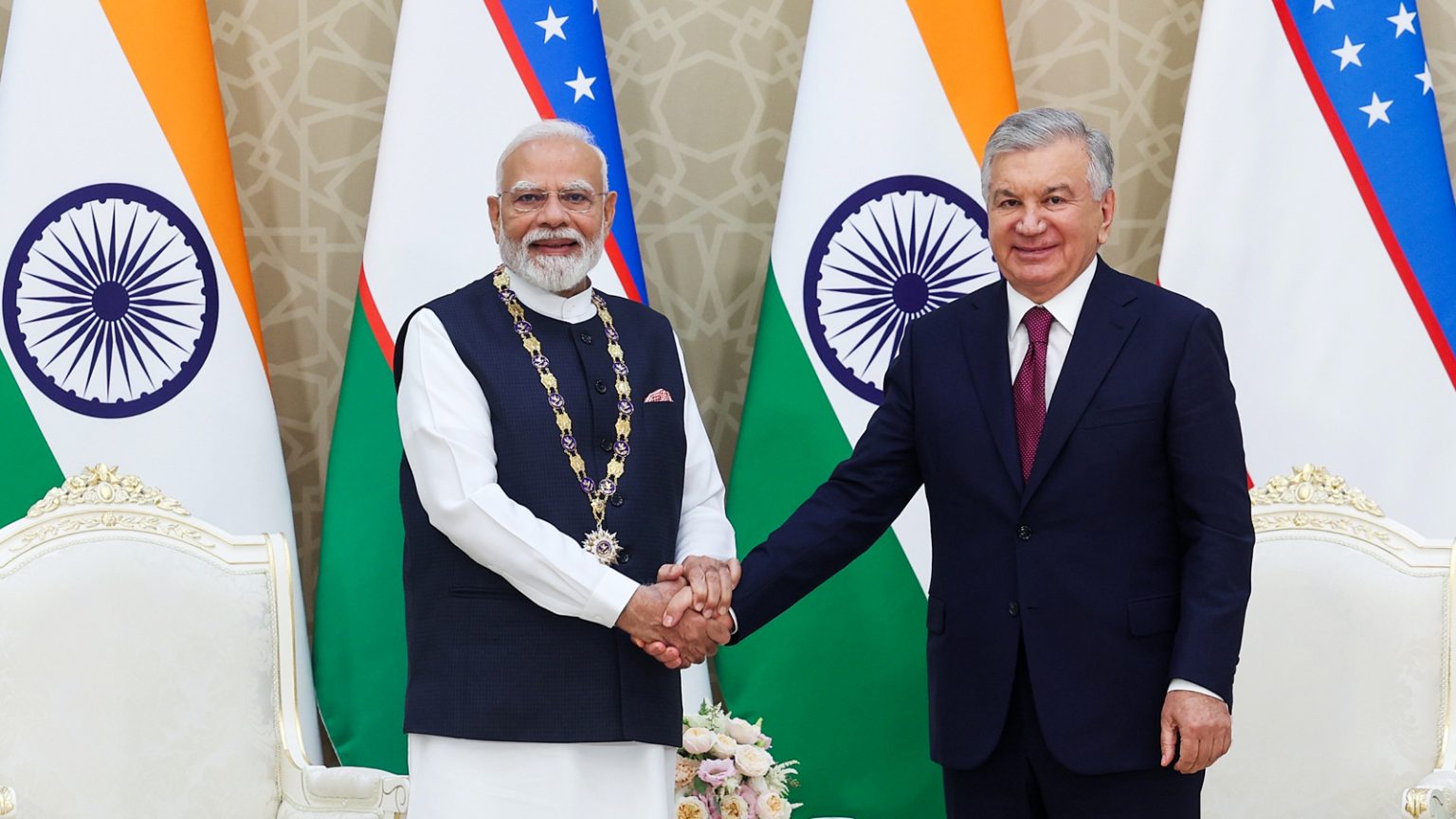
India and Uzbekistan have agreed to deepen their bilateral engagement across trade, investment, defence, connectivity, digital technologies, critical minerals, energy, healthcare, education and culture, with the two countries reaffirming their commitment to elevating ties to a Comprehensive Strategic Partnership.
The understanding was reached during Prime Minister Narendra Modi’s state visit to Uzbekistan from August 29 to 30 at the invitation of Uzbek President Shavkat Mirziyoyev. The two leaders held talks in a warm and constructive atmosphere and reviewed the current state and future prospects of bilateral relations, besides discussing regional and international issues of mutual interest.
The leaders noted the longstanding historical and cultural links between the two countries and stressed the growing importance of Central Asia amid a complex geopolitical environment. They reaffirmed their commitment to a free, open and rules-based international order and agreed to strengthen political dialogue and practical cooperation across a wide range of sectors.
New mechanism for high-level coordination
PM Modi and Mirziyoyev agreed to establish a Foreign Ministers-led mechanism to provide high-level coordination and oversight of bilateral agreements and arrangements and facilitate the timely implementation of priority projects.
The two sides also welcomed growing parliamentary contacts between the Oliy Majlis (Parliament) of Uzbekistan and the Indian Parliament and agreed on the need to review and modernise the existing legal framework governing bilateral cooperation.
On security, India and Uzbekistan unequivocally condemned terrorism, including cross-border terrorism, and reiterated their zero-tolerance approach. They called for concerted action against terrorist organisations, terrorism financing networks, safe havens and infrastructure, while stressing that perpetrators, facilitators, backers and affiliates must be brought to justice.
The countries agreed to strengthen cooperation in law enforcement, intelligence sharing, combating violent extremism, illicit drug trafficking, organised crime and cyber threats. They also reaffirmed the importance of the Joint Working Group on Counter Terrorism.
Defence cooperation was also discussed, with the leaders appreciating regular exchanges, capacity-building and joint activities between their defence and security agencies. They welcomed the activities of the Joint Working Group on Military Cooperation and the successful conduct of the Uzbekistan-India joint military exercise Dustlik, the latest edition of which was held in Uzbekistan’s Namangan region in April 2026.
Focus on trade, investment and business ties
The two countries identified significant scope for expanding bilateral trade and investment and agreed to diversify the range of goods traded while addressing non-tariff barriers.
A Joint Working Group on non-tariff issues and investment barriers will be created, with particular focus on key sectors of bilateral trade. India and Uzbekistan will also explore cooperation in e-commerce, digitalisation of trade procedures and digital platforms to support small and medium-sized enterprises.
The two sides agreed to strengthen manufacturing and export capacities, promote regulatory dialogue and explore mutual recognition arrangements to facilitate greater market access.
The leaders also welcomed the outcomes of the Intergovernmental Commission on Trade, Economic, Scientific and Technical Cooperation and the Uzbekistan-India Business Forums held in June and August 2026.
Electrical goods, engineering products, automobiles and pharmaceuticals were identified as sectors with strong potential for closer business-to-business cooperation.
India and Uzbekistan further agreed to identify mutually beneficial investment opportunities and establish an institutional mechanism to address investor concerns and improve ease of doing business. Cooperation between Uzbekistan’s Investment Promotion Agency and Invest India will also be explored through business forums, roadshows and investment seminars.
Recalling the conclusion of the Joint Feasibility Study on a Uzbekistan-India Preferential Trade Agreement, the leaders directed the relevant ministries to explore the next steps within a time-bound framework.
Uzbekistan also appreciated India’s support for its accession to the World Trade Organization, with both sides agreeing to work together to protect the multilateral trading system with the WTO at its core, particularly in the interests of developing countries.
Critical minerals and energy cooperation
India and Uzbekistan agreed to explore cooperation in geology, mining, nuclear energy, industrial cooperation and critical and strategic minerals.
The proposed cooperation will cover geological exploration, mining, mineral processing, production of value-added products and recycling initiatives. India will encourage its companies to participate in developing prospective mineral deposits in Uzbekistan, while Uzbek enterprises will be encouraged to explore joint collaboration in India.
The two sides also expressed interest in expanding cooperation in the peaceful uses of nuclear energy, renewable energy and modernisation of energy infrastructure.
Agriculture and connectivity
The leaders agreed to strengthen cooperation in agriculture and food security, including agricultural value chains, export capabilities and technical capacity in agriculture and livestock.
They also emphasised innovation and resource-efficient technologies and agreed to facilitate bilateral trade in agricultural products. Research institutions and enterprises will be encouraged to collaborate on agricultural productivity and the conservation and sustainable use of plant genetic resources.
On connectivity, India and Uzbekistan reaffirmed their commitment to developing multimodal transport routes and logistics corridors to facilitate the movement of goods and reduce transportation costs.
The countries will also exchange expertise in advanced road construction technologies and explore joint projects for road infrastructure reconstruction and modernisation. Cooperation will also be explored in environmentally friendly and energy-efficient public transport solutions for Uzbekistan.
AI, digital technology and space cooperation
The two leaders welcomed the successful operation of Tashkent’s first IT Park, established in 2019 based on the Indian model with support from the Software Technology Parks of India.
They agreed to expand partnerships among technology parks, companies, startups and educational institutions.
India and Uzbekistan also agreed to strengthen cooperation in high technologies and digital transformation and build on understandings reached in February 2026 on the margins of the India AI Impact Summit in New Delhi.
The two countries will work together on the development of safe, secure and trustworthy artificial intelligence systems, including through the exchange of experience and best practices aimed at using AI for sustainable economic growth, innovation and addressing societal challenges.
The leaders also reaffirmed their interest in expanding cooperation in the peaceful exploration and use of outer space, including space applications, scientific data exchange and capacity-building through joint workshops and training.
Education, healthcare and pharmaceuticals
The leaders recognised the contribution of Indian students to people-to-people ties and welcomed the expansion of India studies in Uzbekistan and Uzbek studies in India.
They agreed to strengthen human resource development through joint research and academic cooperation.
India’s long-standing capacity-building partnership with Uzbekistan was also highlighted. More than 2,700 Uzbek nationals have participated in the Indian Technical and Economic Cooperation (ITEC) programme, while more than 400 Uzbek students have received ICCR scholarships, including under AYUSH. Uzbekistan welcomed India’s announcement of the Lal Bahadur Shastri Scholarship for Hindi Language in the country.
The two sides agreed to expand cooperation in public health, biomedical research and medical innovation. They also welcomed growing pharmaceutical cooperation and identified the Tashkent Pharma Park Innovative Scientific and Industrial Pharmaceutical Cluster as a platform for joint projects, investment, technology transfer, localisation of manufacturing and skill development.
India and Uzbekistan also expressed support for establishing new medical centres, laboratories, research institutions and joint pharmaceutical manufacturing enterprises in Uzbekistan in cooperation with Indian companies.
Cultural, environmental and people-to-people cooperation
The two countries agreed to strengthen cultural and humanitarian exchanges through cultural days, festivals, exhibitions and artistic tours. They welcomed the signing of the Cultural Exchange Programme for 2026-2030 and cooperation in the field of archives.
India and Uzbekistan will also cooperate on the preservation, restoration and promotion of World Heritage sites, including through digitalisation, 3D modelling of archaeological artefacts and advanced conservation technologies. The leaders welcomed the Letter of Intent on the conservation and restoration of the ancient Buddhist sites of Fayaz Tepa and Karatepa.
The two sides agreed to strengthen sports cooperation, including athlete preparation and coach training in badminton, archery and chess.
They also welcomed cooperation in promoting yoga in Uzbekistan, including instructor training, participation in international Yogasana competitions and the involvement of Indian experts. The two countries also welcomed the conclusion of an MoU on traditional medicines.
On environmental cooperation, India and Uzbekistan agreed to work together on the greening and ecological rehabilitation of the Aral Sea region. The rehabilitation efforts, involving US $1 million and necessary technical support, will be undertaken under India’s Grant-in-Aid framework, drawing on the shared environmental objectives of Uzbekistan’s “Yashil Makon” and India’s “Ek Ped Maa Ke Naam” initiatives.
Cooperation in UN, SCO and Global South
The leaders reaffirmed the central role of the United Nations in maintaining global peace and security and called for comprehensive UN reform, including reform of the Security Council, to make it more representative and effective.
Uzbekistan reaffirmed its support for India’s candidature for permanent membership of the UN Security Council.
The two sides also agreed to strengthen coordination in international forums in support of the common interests of Global South countries.
India and Uzbekistan reaffirmed their commitment to strengthening cooperation within the Shanghai Cooperation Organisation (SCO) as a platform for regional peace, security and stability and greater economic, investment, trade, cultural and humanitarian cooperation.
President Mirziyoyev congratulated PM Modi on India’s BRICS Chairship in 2026 and wished India success in hosting the BRICS Summit. PM Modi, in turn, expressed confidence in Uzbekistan’s successful chairship of the Non-Aligned Movement (NAM) for 2027-2030 and reaffirmed India’s readiness to support the Movement as a founding member.
The Indian side also welcomed Uzbekistan’s interest in joining the International Big Cat Alliance (IBCA) and the International Solar Alliance (ISA). India said it was ready to pursue the necessary consultations and processes for Uzbekistan’s accession.
At the conclusion of the visit, PM Modi thanked President Mirziyoyev, the Uzbek government and people for their hospitality and invited the Uzbek President to pay a return visit to India. The dates for the visit will be decided through diplomatic channels.