

Assam Cabinet Greenlights Key Reforms: Boost for Industry, Education, and Tourism
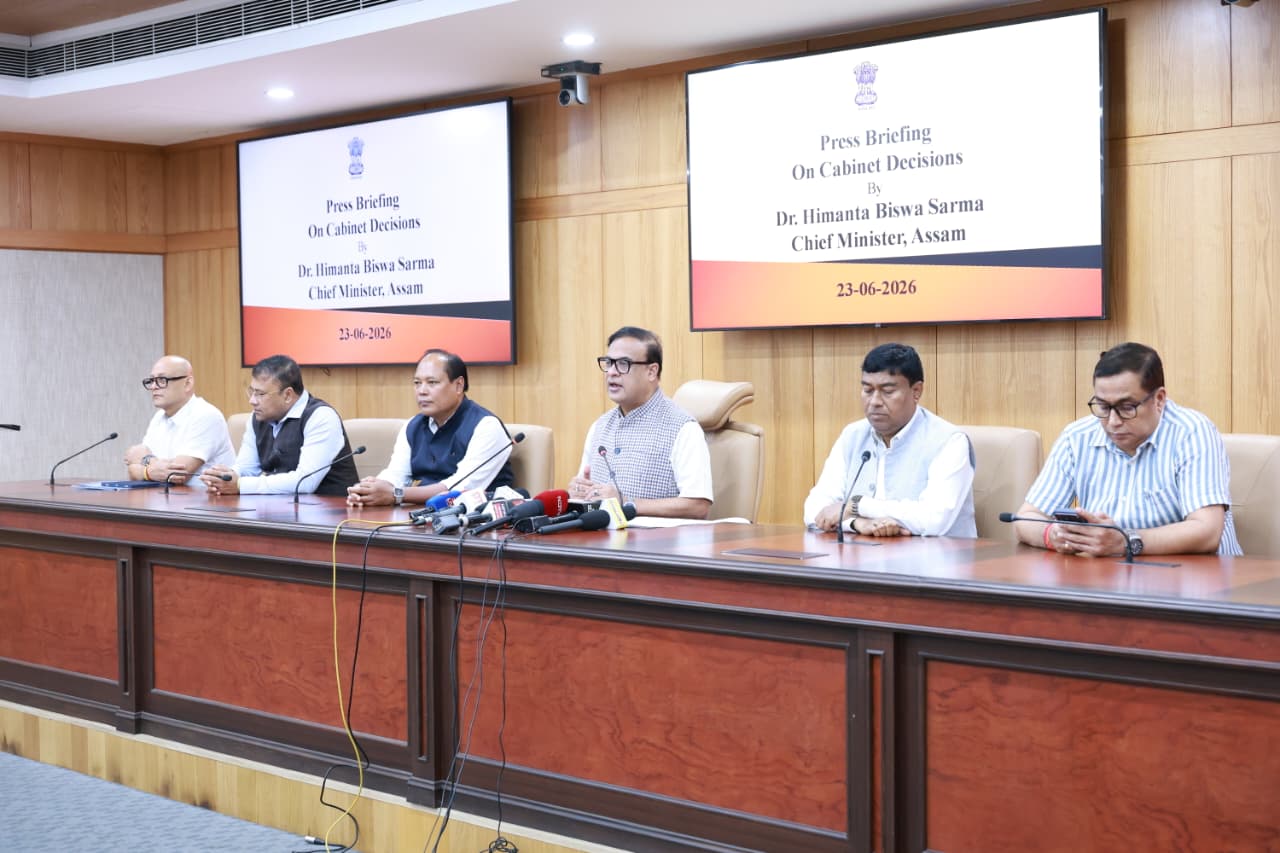
In a major push toward economic growth, regulatory ease, and educational accessibility, the Assam State Cabinet met today at Lok Sewa Bhawan under the chairmanship of Chief Minister Dr. Himanta Biswa Sarma. The high-level meeting resulted in several landmark decisions spanning land re-classification, education infrastructure, public distribution, and tourism.
Here are the key takeaways from today’s Cabinet meeting:
1. Land Re-classification Law Amended to Fuel Investments
In a bid to streamline the regulatory environment and attract robust industrial and commercial investments, the Cabinet approved the Assam Regulation of Re-classification and Re-classification cum Transfer of Lands (Amendment) Bill, 2026.
- The Bill will be introduced in the upcoming Budget Session of the Assam Legislative Assembly.
- It will fast-track land re-classification (including agriculture to non-agriculture conversions) for vital sectors such as MSMEs, Hydrocarbons, and Solar Energy.
2. Lifeline Extension for Fair Price Shops
To ensure that foodgrain distribution to National Food Security Act (NFSA) beneficiaries remains seamless and uninterrupted across the state, the Cabinet has extended the validity of all Fair Price Shop (FPS) licenses.
- The existing expiration deadline of June 30, 2026, has now been pushed to December 31, 2026.
3. Relief for Assam Tea Corporation Executives
The Cabinet approved the immediate release of ₹9.75 crore to the Assam Tea Corporation Ltd. (ATCL). This dedicated fund will be utilized by ATCL to clear the proposed Voluntary Retirement Scheme (VRS) packages for its executives.
4. Boost for Private Universities: Land Requirements Slashed
To encourage higher education infrastructure, the Cabinet approved amendments to the Assam Private Universities Act, 2007, significantly lowering the minimum land requirement for setting up private universities:
- Rural Areas: Reduced from 60 bighas to 35 bighas.
- Urban Areas: Reduced from 30 bighas to 21 bighas.
5. New Norms for Schools: Priority on Safety Over Space
The Cabinet approved a pragmatic proposal for the School Education Sector, relaxing the minimum built-up area required for Lower Primary (LP) to Secondary schools while strictly enforcing safety and academic standards.
| Location | Minimum Built-Up Area Required |
| Urban Areas | 1 bigha |
| Rural Areas | 3 bighas |
Mandatory Compliance: Regardless of size, all schools must strictly provide functional sanitation, safe drinking water, boundary walls, separate toilets, disaster mitigation compliance, and Divyang-friendly (accessible) infrastructure.
6. Single-Window Registration for Home Stays
To boost local hospitality and eco-tourism, the Cabinet approved ‘The Assam Tourism Accommodation (Development & Registration) Rules, 2026’. This framework introduces a hassle-free, single-window registration process for homestays and similar accommodations, featuring an automated renewal mechanism every three years.