

Stakeholders unite in Guwahati to address Spring degradation across Northeast India
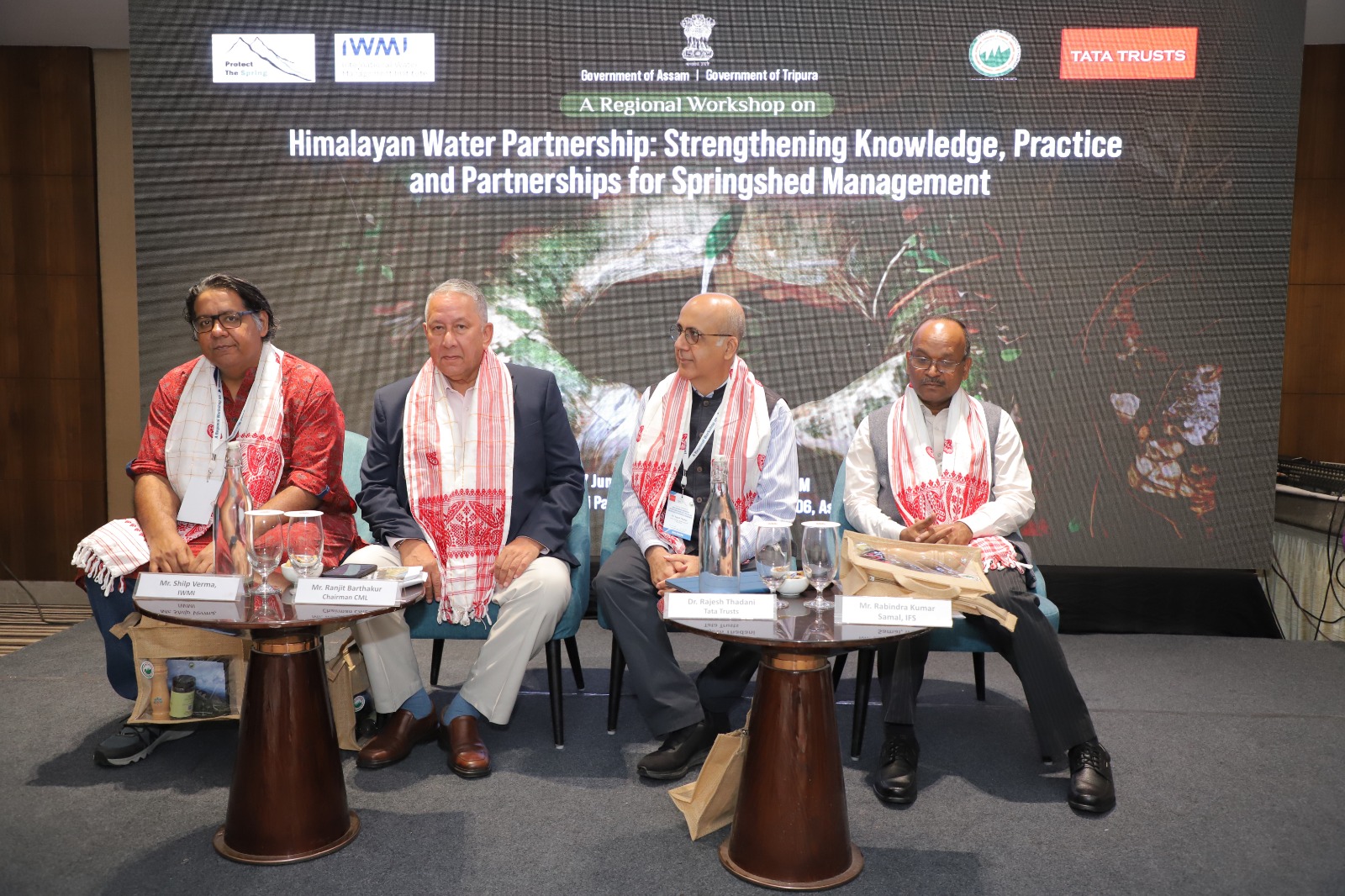
The Regional Workshop on “Himalayan Water Partnership: Strengthening Knowledge, Practice and Partnerships for Springshed Management” was held today at Hotel Ratnamouli Palace, Guwahati, bringing together experts, policymakers, government officials, practitioners, researchers and development organizations from across Northeast India and the Himalayan region to deliberate on the growing crisis of spring degradation and the need for integrated springshed management.
Organized under the Himalayan Water Partnership initiative, the workshop served as a platform for knowledge exchange, cross-learning and policy dialogue on spring rejuvenation, groundwater governance and climate-resilient water security.
The inaugural session commenced with a welcome and context-setting by Mr. Divyang Waghela, Tata Trusts, who highlighted the importance of collaborative efforts in addressing the declining health of mountain water sources. Dr. Rajesh Thadani, Tata Trusts, emphasized the urgent need for collective action to safeguard springs, which remain the lifeline of millions of people across the Himalayan and Northeastern regions.
Addressing the gathering, Mr. Ranjit Barthakur, Chairman, Centre for Microfinance and Livelihood (CML) and Founder & President of the Balipara Foundation, stressed the importance of community stewardship and ecosystem restoration for long-term water security. Mr. Rabindra Kumar Samal, IFS, Principal Secretary (Forests), Government of Tripura, underscored the role of forests and catchment protection in sustaining groundwater recharge and spring flows. The session also featured a short film showcasing successful spring rejuvenation initiatives undertaken by CML across Northeast India.
Hydrological Science for Sustainable Water Management
The first technical session focused on the scientific understanding of springs and groundwater systems in the Eastern Himalayan region. Dr. Himanshu Kulkarni of ACWADAM discussed the unique hydrogeological characteristics of Northeast India and emphasized the need to understand springs as groundwater systems linked to larger recharge landscapes. He highlighted the importance of combining scientific knowledge with local ecological understanding to improve water management outcomes.
Mr. Jagdish Krishnaswamy of Indian Institute for Human Settlements (iihs) presented insights on the role of ecological data, landscape analysis and evidence-based approaches in strengthening springshed governance and informing sustainable water management decisions.
The panel discussion on “Hydrogeology of North-Eastern States and Potential for Sustainable Water Security”, chaired by Dr. Rajesh Thadani, brought together experts from the Central Ground Water Board, Meghalaya Basin Development Authority, IWMI, Jal Jeevan Mission-Assam, HITA and academia. The panel deliberated on the diverse hydrogeological settings of the Northeast, the implications of climate variability on groundwater recharge, and the importance of scientific spring inventories and hydrogeological assessments in designing effective spring rejuvenation interventions. Panelists emphasized that sustainable water security in the region will require stronger linkages between science, policy and community action.
Scaling Springshed Solutions: Practice, Governance and Policy Pathways
The second session highlighted experiences from the field and explored opportunities for scaling springshed management across the region. Dr. Vinod Kothari of Himmotthan Society shared lessons from the Spring Atlas initiative in the Central and Western Himalayas, demonstrating how scientific mapping and documentation can support large-scale spring restoration efforts.
Dr. Subash Dhakal from the Government of Sikkim presented the state’s experience in springshed management and emphasized the value of participatory approaches involving local communities in spring mapping, planning and monitoring. Mr. A. Muralidharan of NITI Aayog discussed financing mechanisms and institutional partnerships required for strengthening mountain water security and scaling successful models across different geographies.
The concluding panel discussion on “Role of Technology, Community in Spring-shed Management and Need of an Integrated Policy Framework” brought together representatives from NABARD, district administration, research institutions and civil society organizations. Discussions highlighted that technology alone cannot revive springs unless complemented by community ownership, traditional knowledge and long-term institutional support. Panellists stressed the importance of convergence between programmes such as MGNREGA, watershed development initiatives, Jal Jeevan Mission and forest restoration efforts to ensure sustainable outcomes. The need for dedicated policy support, improved groundwater governance and greater investment in spring rejuvenation was also strongly emphasized.
The workshop concluded with a shared commitment to strengthen collaboration among governments, scientific institutions, development organizations and local communities under the Himalayan Water Partnership. Participants agreed on the need to develop a regional roadmap for scaling springshed management, promoting scientific spring inventories, strengthening groundwater governance and integrating spring rejuvenation into development planning processes across Northeast India.
The deliberations reinforced the recognition of springshed management as an integrated approach that combines hydrogeological science, ecosystem restoration, community participation and policy convergence to improve water security, enhance climate resilience and sustain livelihoods in the fragile mountain ecosystems of Northeast India.