

India gets its 3rd nuclear submarine? What we know about INS Aridhaman so far
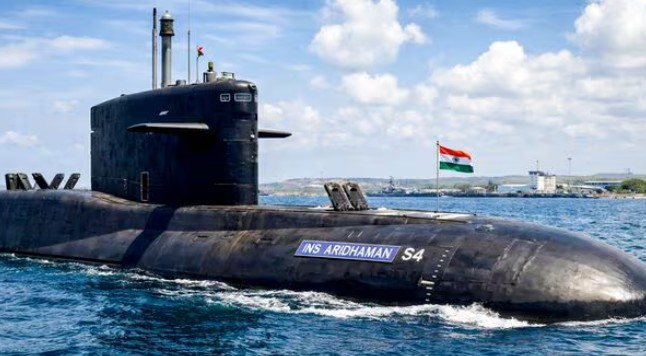
Defence Minister Rajnath Singh hinted at the launch of India’s third indigenously built nuclear-powered submarine, INS Aridhaman, in a post on X. He described it as “not a word, it’s power, ‘Aridhaman’.” Notably, INS Aridhaman has completed its final sea tests and will soon become part of the Strategic Forces Command. This submarine comes after INS Arihant, which joined in 2016, and INS Arighaat, commissioned in August 2024.
Enhanced capabilities
The submarine displaces around 7,000 tonnes, slightly larger than its predecessors, and features a more streamlined hull for improved stealth and acoustic performance. It is powered by an upgraded 83 MW pressurised water reactor developed by the Bhabha Atomic Research Centre.
Aridhaman carries eight vertical launch tubes double the capacity of INS Arihant allowing it to deploy either eight K-4 long-range missiles with a 3,500 km range or up to 24 K-15 missiles with a 750 km range. This capability ensures continuous at-sea deterrence, keeping at least one nuclear-armed submarine on patrol at all times.
Strategic importance of SSBNs
Ship, Submersible, Ballistic, Nuclear (SSBN) vessels like Aridhaman provide India with a credible second-strike capability. Even if land-based silos or airbases are attacked, SSBNs submerged deep underwater can retaliate, making a first strike against India strategically suicidal.
Currently, India operates INS Arihant and INS Arighaat. The induction of Aridhaman as the third SSBN, followed by a planned fourth, will allow the Indian Navy to maintain one submarine on patrol while others undergo maintenance, transit, or remain as reserves.
Rajnath Singh’s visit to Visakhapatnam
The announcement coincides with Singh’s visit to Visakhapatnam, home to India’s nuclear submarines, where he commissioned the indigenously built advanced stealth frigate Taragiri. Visakhapatnam serves as both the construction hub and home port for India’s SSBN fleet.
Singh while speaking at the event, said the commissioning of Taragiri reflects India’s growing strength at sea. He congratulated the Mazagon Dock Shipbuilders Limited and the Navy for building and inducting the modern warship. He said that as India aims to become a developed nation by 2047, strengthening maritime power will play a key role in achieving that goal.
The Defence Minister said that India, with a coastline of over 11,000 kilometres and surrounded by water on three sides, depends heavily on the seas. He noted that nearly 95% of the country’s trade moves through maritime routes, making the Navy essential for economic and energy security.
He stressed that a strong Navy is not just important, but necessary to protect India’s interests.
Indian Navy’s role in security
Rajnath Singh praised the Navy for protecting commercial ships and oil tankers during times of tension. He said the force has shown it can not only defend India’s borders but also operate globally to safeguard citizens and trade routes when needed. The Defence Minister also said India must go beyond protecting its own shores. He underlined the need to secure key sea lanes, choke points, and even digital infrastructure connected to national interests.
He added that the Indian Navy is already working actively in these areas, strengthening India’s position as a responsible maritime power.
Taragiri frigate
The Taragiri, powered by a Combined Diesel or Gas (CODOG) propulsion system, represents a leap in design with a sleek hull, reduced radar signature, and high-speed, long-endurance performance.
Its weapons include supersonic surface-to-surface missiles, medium-range surface-to-air missiles, and an advanced anti-submarine warfare suite integrated via a modern combat management system.
Beyond combat, Taragiri can also perform humanitarian assistance and disaster relief operations, demonstrating versatility alongside its offensive capabilities.