

Delhi on Edge: Mamata Banerjee, Kejriwal Detained as Opposition Protests Demand Poll Chief’s Removal
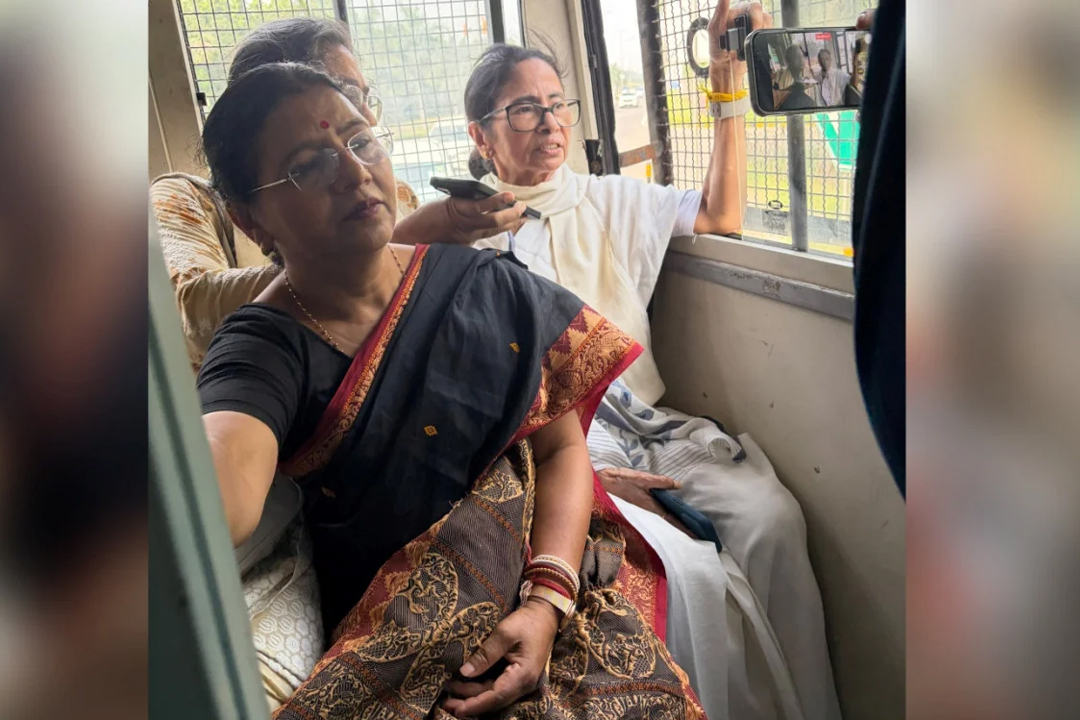
Several opposition leaders and activists, including former Delhi Chief Minister Arvind Kejriwal, former West Bengal Chief Minister Mamata Banerjee and former Kerala Chief Minister Pinarayi Vijayan, were detained in New Delhi on Saturday during protests demanding the removal of Chief Election Commissioner Gyanesh Kumar.
The demonstrations were organised over allegations that revisions to electoral rolls had unfairly benefited Prime Minister Narendra Modi’s Bharatiya Janata Party (BJP). Opposition parties accused the Election Commission of failing to ensure electoral fairness, while the BJP and the poll body denied the allegations.
Thousands of security personnel were deployed across the national capital as authorities imposed extensive restrictions to prevent the planned demonstrations. Several metro stations and markets were reportedly closed, while mobile internet services were suspended in parts of central Delhi.
Mamata Banerjee Detained During Dharna
The Delhi Police detained Mamata Banerjee and her party colleague Dola Sen while they were staging a sit-in protest near the South Avenue bus stand, according to reports.
The Trinamool Congress chief had reportedly announced her intention to participate in a demonstration at Jantar Mantar demanding Gyanesh Kumar’s removal from the post of Chief Election Commissioner.
Police had earlier said that permission had not been granted for the proposed protest and warned that those violating the restrictions would face legal action.
Following the detention, the whereabouts of some protesters and the circumstances surrounding their release were not immediately clear.
Youth Activists and Other Opposition Leaders Detained
The protests also involved members of the youth movement identified in the supplied reports as the Cockroach Janta Party (CJP), which had called for a large demonstration under the banner of saving democracy.
Police reportedly detained CJP founder Abhijeet Dipke and senior leaders Saurav Das and Ashutosh Ranka after their flight from Mumbai landed in Delhi.
Television footage reportedly showed Dipke challenging police officers to arrest him, while an officer responded that the action was not an arrest and asked him to cooperate.
In a pre-recorded video posted on social media, Dipke said that Ajinkya Shinde, the movement’s organisational in-charge, would lead the protest at Jantar Mantar.
Germany-based YouTuber Dhruv Rathee was also reportedly detained at his residence in Gurugram after he declined requests from police not to travel to Delhi for the demonstration.
Activists, including Yogendra Yadav and Prashant Bhushan, were also named among those detained in reports about the protests. Some lawyers demonstrating outside the Supreme Court were reportedly detained as well.
The CJP condemned the detention of its leaders, describing it as a pre-planned attempt to disrupt the demonstration, and demanded their immediate release. Representatives of two digital media organisations also alleged that police had detained four journalists covering the protests.
There was no immediate detailed response from the Delhi Police regarding all the reported detentions.
Delhi Sees Tight Security Restrictions
Authorities imposed extensive security measures across the capital to prevent protesters from gathering in large numbers.
Reports said 45 metro stations and several markets were closed, while mobile internet services were suspended in the central business district. Police personnel checked buses at entry points into the city, and vehicles were subjected to additional inspections.
Barricades and concrete blocks were placed along several roads, while anti-riot vehicles equipped with tear gas launchers were stationed at key locations.
The restrictions delayed the protesters’ plans to assemble at Jantar Mantar, a designated protest site in central Delhi, at 10 am.
Before leaving Mumbai, Dipke questioned the need for the restrictions, asking why railway services, metro operations, internet connectivity and roads had been affected.
The protesters maintained that demonstrating against alleged electoral irregularities was a fundamental democratic right.
Row Over Electoral Roll Revisions
The demonstrations followed a report by The Indian Express stating that officials working under Chief Election Commissioner Gyanesh Kumar had questioned or disagreed with aspects of the revision of electoral rolls.
According to the report cited in the supplied material, approximately 130 million voter entries were removed during the verification exercise. The figure has become a major point of contention between opposition parties and the Election Commission.
Opposition leaders alleged that the revisions disproportionately affected voters and could influence election outcomes in favour of the BJP. They also questioned the independence of the Election Commission and demanded accountability over the deletions.
The Election Commission, however, has said that the figures relate to voter entries flagged during the draft revision process. It has maintained that people whose names were wrongly removed can register again.
The commission and the BJP have denied allegations of manipulating voter lists for political advantage.
According to the figures cited in reports, the deleted entries included approximately 63 million people who had relocated, 30 million who could not be traced and 28 million who had died.
The opposition has argued that the scale of the deletions raises concerns about electoral fairness, particularly ahead of a series of state elections scheduled to begin in early 2027.
Political Tensions Ahead of Key State Elections
The protests have added to the political confrontation between opposition parties and the BJP-led government over the functioning of electoral institutions.
Opposition parties have repeatedly raised concerns about voter-list revisions, alleging that the process could undermine democratic representation. The BJP has rejected the accusations, arguing that its electoral success reflects public support for Prime Minister Narendra Modi and the government’s economic policies.
The latest demonstrations come amid heightened political activity ahead of several important state elections expected in 2027.
As demands for the removal of the Chief Election Commissioner continue, the controversy over electoral roll revisions is likely to remain a major issue in the debate over electoral transparency and democratic accountability.