

India Ranks 3rd Among Asia’s Most Powerful Countries, PM Modi Named 2nd Most Influential Regional Leader
India has retained its position as the third-most powerful country in Asia, reinforcing its growing influence in the region. Prime Minister Narendra Modi has also been ranked the second-most effective regional leader, behind Chinese President Xi Jinping, according to the Lowy Institute’s Asia Power Index 2026.
The latest ranking highlights India’s steady rise as a major regional power, supported by its growing defence partnerships, economic relationships and diplomatic engagement. The report also points to India’s expanding role in shaping the strategic and political landscape of Asia.
According to the index, India’s overall power score increased by 0.5 points to 40.5 in 2026. This has brought the country closer to China than at any point since the index was first introduced in 2018.
The United States and China continue to dominate the rankings, retaining their positions as Asia’s two leading superpowers. The US secured 78.9 points, while China followed with 73.6 points, out of a maximum of 100.
The report attributes India’s growing regional influence to several factors, particularly its expanding defence engagement with Southeast Asian nations. The sale of BrahMos missiles to countries in the region has strengthened India’s defence partnerships and expanded its strategic network.
India’s stable trade and investment relationships have also played an important role in maintaining its economic connections, even as several other countries experienced a weakening of their external economic ties.
One of the notable highlights of the report is India’s diplomatic standing. Experts surveyed for the index ranked Prime Minister Narendra Modi as the second-most effective regional leader after Chinese President Xi Jinping. However, the report observed that India’s relatively low-profile response during the Gulf conflict affected perceptions of the Prime Minister’s global leadership.
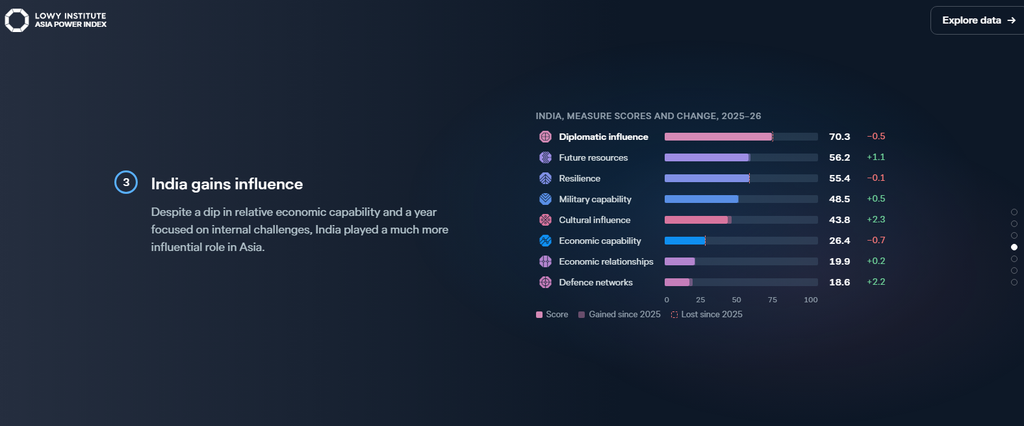
India also registered considerable progress in several key areas of national power. Its biggest improvement came in cultural influence, where it gained 2.3 points. The country also improved its defence networks by 2.1 points, future resources by 1.2 points and military capability by 0.5 points.
However, the country’s economic capability score declined by 0.7 points. Its scores for resilience, economic relationships and diplomatic influence remained unchanged.
In terms of individual indicators, India scored 26.4 in economic capability, 43.8 in cultural influence and 70.3 in diplomatic influence.
The report also highlighted the changing balance of power between the United States and China. The gap between the two countries has narrowed to just 5.3 points, the smallest difference recorded since the Asia Power Index was launched in 2018. Their military capability gap has also narrowed to its lowest level.
The United States, meanwhile, witnessed a significant decline in diplomatic influence, losing six points to reach 76.7. This marks its steepest fall and the fourth consecutive annual decline in the indicator.
The report linked the decline to several geopolitical developments, including the Iran war, punitive tariffs and calls for reducing military exercises with South Korea.
Commenting on the broader regional situation, Hunter Marston, Director of the Southeast Asia Program and Asia Power Index, observed that despite the changing geopolitical environment, the balance of power in Asia continues to be dominated by the United States and China. He noted that neither the emergence of a middle-power bloc nor closer authoritarian alignment has displaced the influence of the two superpowers.
Reacting to India’s improved standing, Union Minister Kiren Rijiju credited Prime Minister Narendra Modi’s leadership for the country’s progress. Speaking to reporters on Monday, Rijiju said India had undergone significant changes over the past 12 years and had advanced considerably in the economic, military and financial sectors.
He pointed out that several international rating agencies had placed India among the world’s leading countries in different areas. Responding to criticism from the Opposition, the minister maintained that political differences should not overshadow the country’s overall progress.
The 2026 edition of the Lowy Institute’s Asia Power Index evaluates 27 countries and territories across 131 indicators to assess their economic resources, military strength, diplomatic influence, cultural reach and overall strategic standing.
India’s continued presence among Asia’s top three powers reflects its growing regional importance. While challenges remain, particularly in strengthening economic capabilities, the latest assessment underlines the country’s expanding influence in defence, diplomacy and regional partnerships.