

Mysterious Repeated Outbursts from a Mass0ive Star Explained; NASA Uncovers Hidden Companion
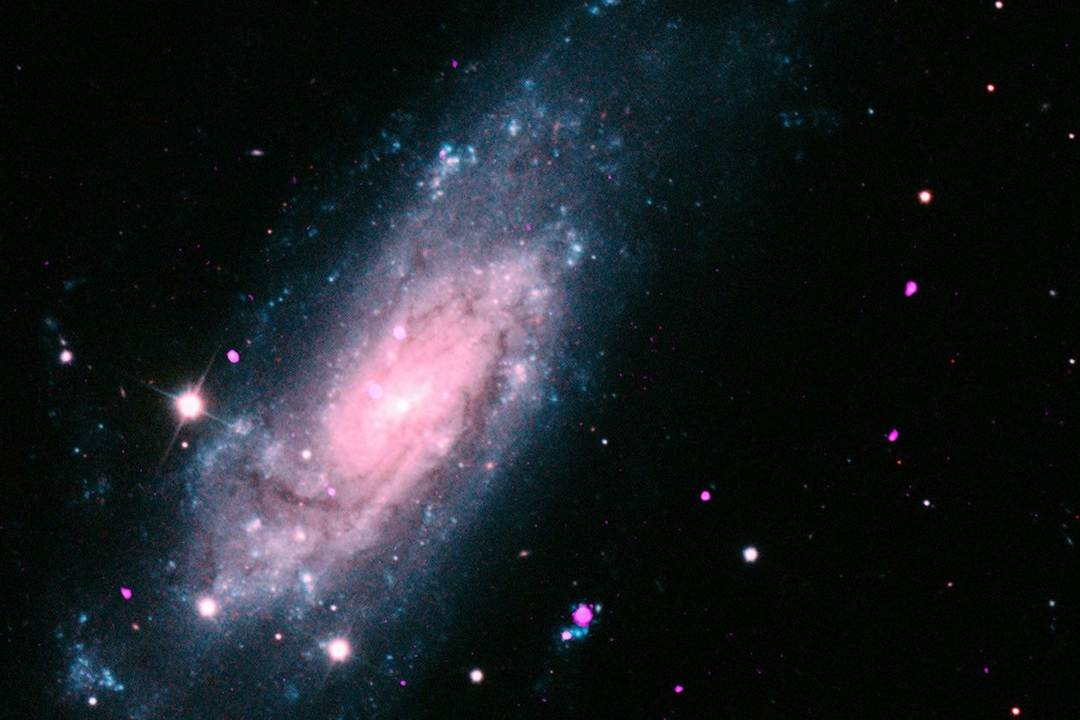
Astronomers have uncovered the mystery behind the repeated brightening and dimming of a massive star, AT 2016blu, using data from NASA’s Chandra X-ray Observatory. Researchers believe the star has an invisible companion, possibly a black hole or a neutron star, which comes extremely close to it every 113 days as they orbit each other.
The findings have been published in The Astrophysical Journal. Scientists say this discovery marks the first time X-ray emissions have been detected from a supernova impostor, as well as the first identification of a possible black hole or neutron star companion to such an object.
Located approximately 30 million light-years away in the galaxy NGC 4559, AT 2016blu is a massive and extremely hot star belonging to the Luminous Blue Variable (LBV) class. It has a mass at least 33 times that of the Sun.
The star repeatedly brightens in a manner similar to a supernova explosion but survives each episode without being destroyed. Such events are known as ‘supernova impostors’.
Between 2012 and 2026, researchers observed at least 27 major brightening episodes from the star, occurring approximately every 113 days.
The research was led by Mozghan Aghakhanloo of the University of Virginia. According to her, scientists had been monitoring the star’s unusual behaviour for nearly 15 years but could not determine its cause due to a lack of timely observations from the Chandra telescope.
Co-author Nuria Torres-Alba noted that the star repeatedly behaved like a supernova but survived, making X-ray observations during its brightening episodes particularly important.
Another bright X-ray source is located very close to AT 2016blu. NASA’s Chandra X-ray Observatory has the capability to distinguish between these two sources.
In March 2026, Chandra observed the star during one of its outbursts and detected X-ray emissions at least 100 times brighter than those recorded in 2001 and 2002.
Scientists believe the star and its invisible companion orbit each other along an elliptical path. When they come closest to each other, the companion, potentially a black hole or neutron star, pulls in material released by the massive star.
This interaction generates intense X-ray emissions, making the event appear like an explosion when observed from Earth.
The discovery not only solves the mystery surrounding the unusual behaviour of AT 2016blu but also provides new insights into complex astronomical phenomena.
Scientists believe AT 2016blu could potentially be classified as an Ultra-luminous X-ray Source (ULX). These rare and exceptionally bright objects remain a subject of ongoing astronomical research.
The findings could help scientists better understand the life cycles of massive stars, their interactions with black holes and neutron stars, and the powerful phenomena occurring across the universe.