

Two Geo-Tagged Amur Falcons Return to Manipur After Journey Across 23 Countries
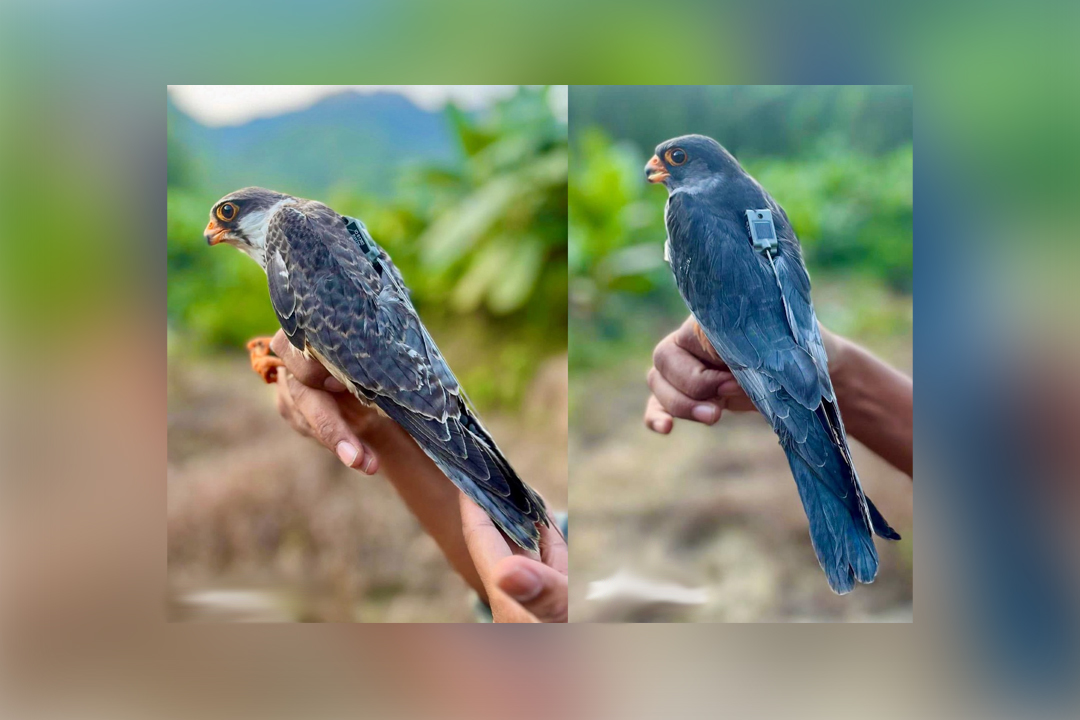
Alang and Apapang complete their annual migration across Asia and Africa, marking a milestone in conservation efforts
Two geo-tagged Amur falcons, named Alang and Apapang, returned to Tamenglong district in Manipur on Thursday after completing their annual migratory journey across 23 countries in Asia and Africa.
In a statement issued on Friday, the Divisional Forest Officer of Tamenglong described the development as an “encouraging milestone” in the ongoing Amur Falcon Conservation Project.
The two birds were geo-tagged in November 2025 at the Chiuluan roosting site in Tamenglong district to track their migration patterns and movements.
Amur falcons are migratory birds roughly the size of pigeons, weighing between 95 and 188 grams. They breed during the summer in Siberia and northern China before beginning their long journey to their wintering grounds in southern Africa.
With the onset of winter, the birds stop over in Nagaland, Manipur and Assam, usually arriving between mid-October and early November. They spend around three weeks at these locations feeding and resting to build up fat reserves before undertaking a non-stop flight across the Indian Ocean to southern Africa.
The birds are known for their remarkable annual round-trip migration, covering between 20,000 and 30,000 kilometres.
The successful return of Alang and Apapang highlights the importance of scientific research, satellite tracking, continuous monitoring and community participation in wildlife conservation, the forest department said.
The development also reinforces Tamenglong’s growing importance as a key landscape for Amur falcon conservation.
The geo-tagging programme for Amur falcons was initiated in Nagaland in 2013 by the Wildlife Institute of India (WII) and the Union Forest Ministry. The initiative was subsequently extended to neighbouring Manipur in 2019.
Apart from their remarkable migratory journey, Amur falcons play an important ecological role by feeding on insects and helping maintain ecological balance.
Union Environment, Forest and Climate Change Minister Bhupender Yadav said in a post on X on Friday that the two falcons had arrived in Manipur after travelling from their breeding grounds in northeastern China.
According to the minister, the birds’ return marks the successful completion of nearly a year of satellite tracking and their round-trip journey since they were tagged by WII scientists in November 2025. He described the Amur falcons as “global citizens” because of their extensive migration across Asia and Africa.
Yadav said the birds are expected to spend two to three weeks at selected sites in Tamenglong before continuing their journey.
During this stopover, the falcons will feed on termites emerging in and around their roosting areas to replenish the fat reserves required for the next stage of migration.
The minister said the birds would then undertake a nearly 6,000-kilometre, non-stop flight from Manipur to Somalia, lasting approximately six days. The journey will include a crossing of around 3,000 kilometres over the Arabian Sea.
Amur falcons were once hunted extensively for their meat in parts of Northeast India. However, the situation has improved in Manipur and Nagaland following conservation initiatives launched in 2015, including the Amur Falcon Festival, a forest official said.
Before the conservation efforts began, an Amur falcon reportedly fetched around 30–40.
The successful return of Alang and Apapang demonstrates the value of long-term scientific monitoring and conservation initiatives. It also highlights the importance of protecting the birds’ stopover sites and involving local communities in safeguarding this remarkable migratory species.